Functional Engines for technical training
Our engine training rigs use working engines and original vehicle components. Accessible test points and diagnostic connections let learners investigate the system while it is running.
We build rigs using petrol and diesel engines as well as mild- and full-hybrid drivetrains from different manufacturers. Equipment options depend on your training requirements.
Product overview as PDF
Download our brochure for an overview of the training systems and equipment options in this product area.
Original drivetrain system
The engine, control units, sensors and actuators work together as they would in the vehicle.
Direct measurement access
Breakout boxes and 4 mm test sockets provide access to electrical signals at the working system.
Investigate faults systematically
OBD diagnostics and optional fault simulation allow learners to investigate typical workshop faults.
Engine training rigs for different drivetrains
Our rigs are based on original automotive engines. We mount them on suitable frames and add measurement and diagnostic access for teaching.
We are not tied to one vehicle manufacturer. Depending on the application, we can build rigs using petrol, diesel, mild-hybrid or full-hybrid systems.
Gasoline engines
Modern gasoline engines with direct injection, turbocharging, variable valve timing and electronic engine management.
Diesel engines
Diesel systems with common-rail injection, turbochargers, exhaust aftertreatment and modern engine and vehicle diagnostics.
Mild Hybrid
Combustion engines with an additional electrical system and electric assistance, for example using 48-volt technology.
Full Hybrid
Complete hybrid drivetrains with a combustion engine, electric drive, high-voltage system, power electronics and energy storage.
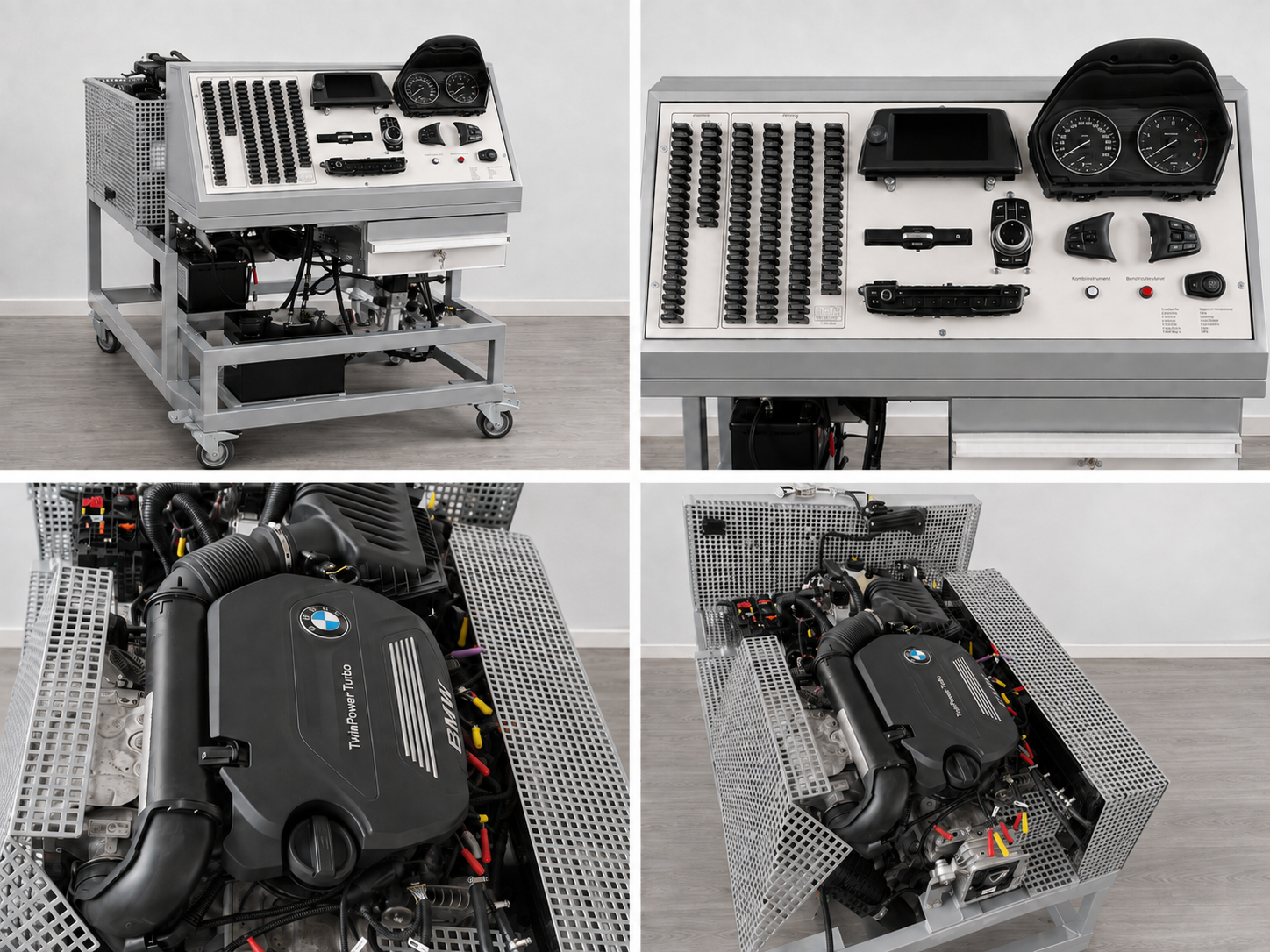
BMW B48 with gasoline direct injection and TwinPower Turbo
An example of a modern fully functional gasoline-engine training rig with original operating, diagnostic and engine technology.
BMW 2.0 HPI B48 functional engine
Fully functional BMW B48 four-cylinder gasoline direct-injection engine with Valvetronic and TwinPower Turbo.
The engine is installed in operating condition with all components required for operation on a stable mobile training frame.
A specially designed instrument console provides the necessary displays and controls in a clear layout for training use.
The freely accessible setup combines conventional engine mechanics with modern electronic engine control and standard workshop vehicle diagnostics.
Toyota Prius III Hybrid Synergy Drive
The engine training rig shows a complete full-hybrid drivetrain, combining the combustion engine, electric drive, high-voltage battery and power electronics in one fully functional system.
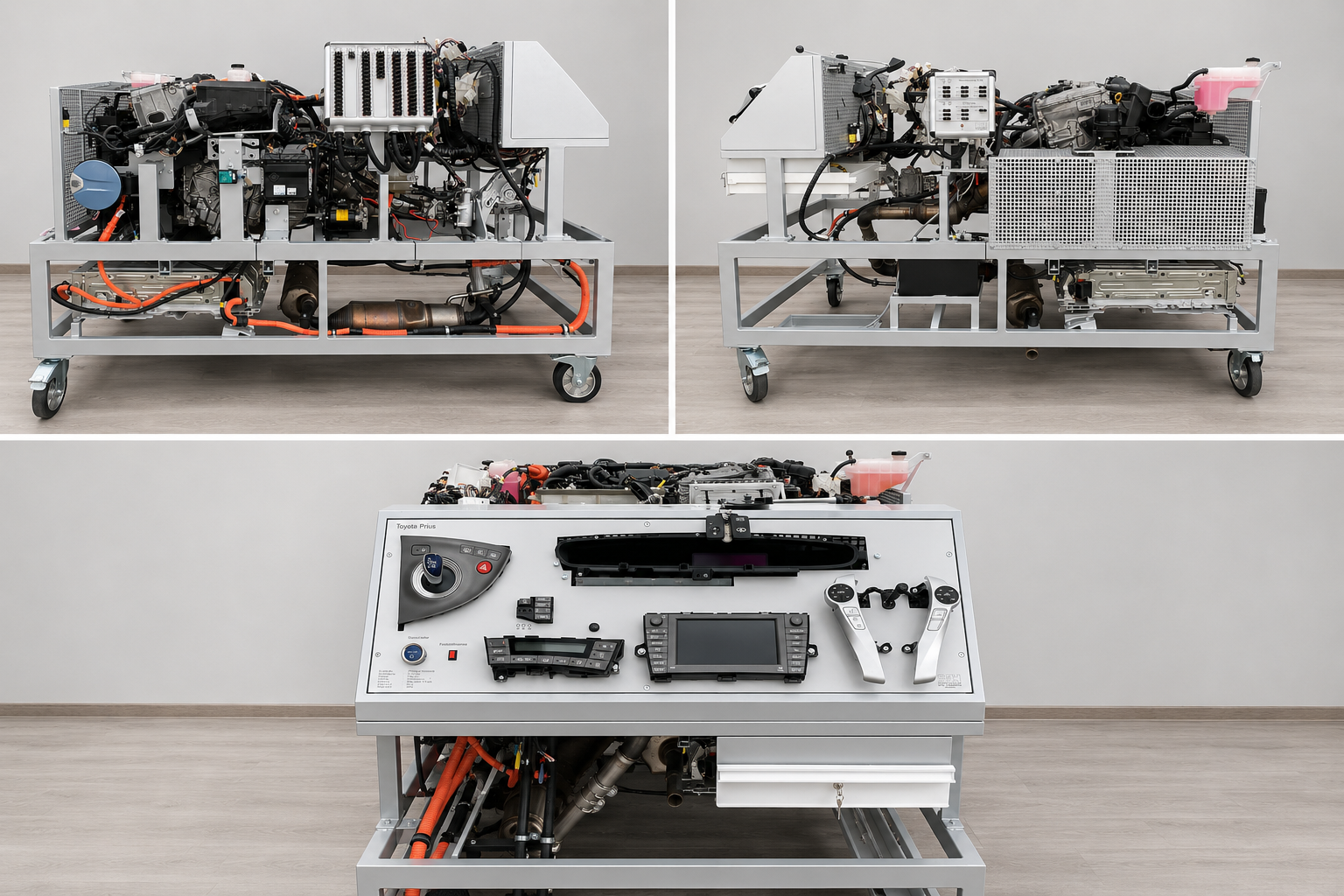
Toyota Prius 3 Hybrid engine training rig
Fully functional engine training rig based on a Toyota Prius III with automatic transmission, high-voltage battery and all key components of the Hybrid Synergy Drive.
The setup has an active vehicle identification number and realistically reproduces the original vehicle system with instruments, controls, immobilizer, wiring harness and diagnostic interface.
Rotating and hot components are protected against accidental contact. The entire setup is mounted on a stable frame with four load-bearing lockable swivel casters.
Ford Fiesta 1.0 L EcoBoost Mild Hybrid
As an example of current mild-hybrid technology, this training rig combines an original combustion engine with the corresponding 48-volt system.
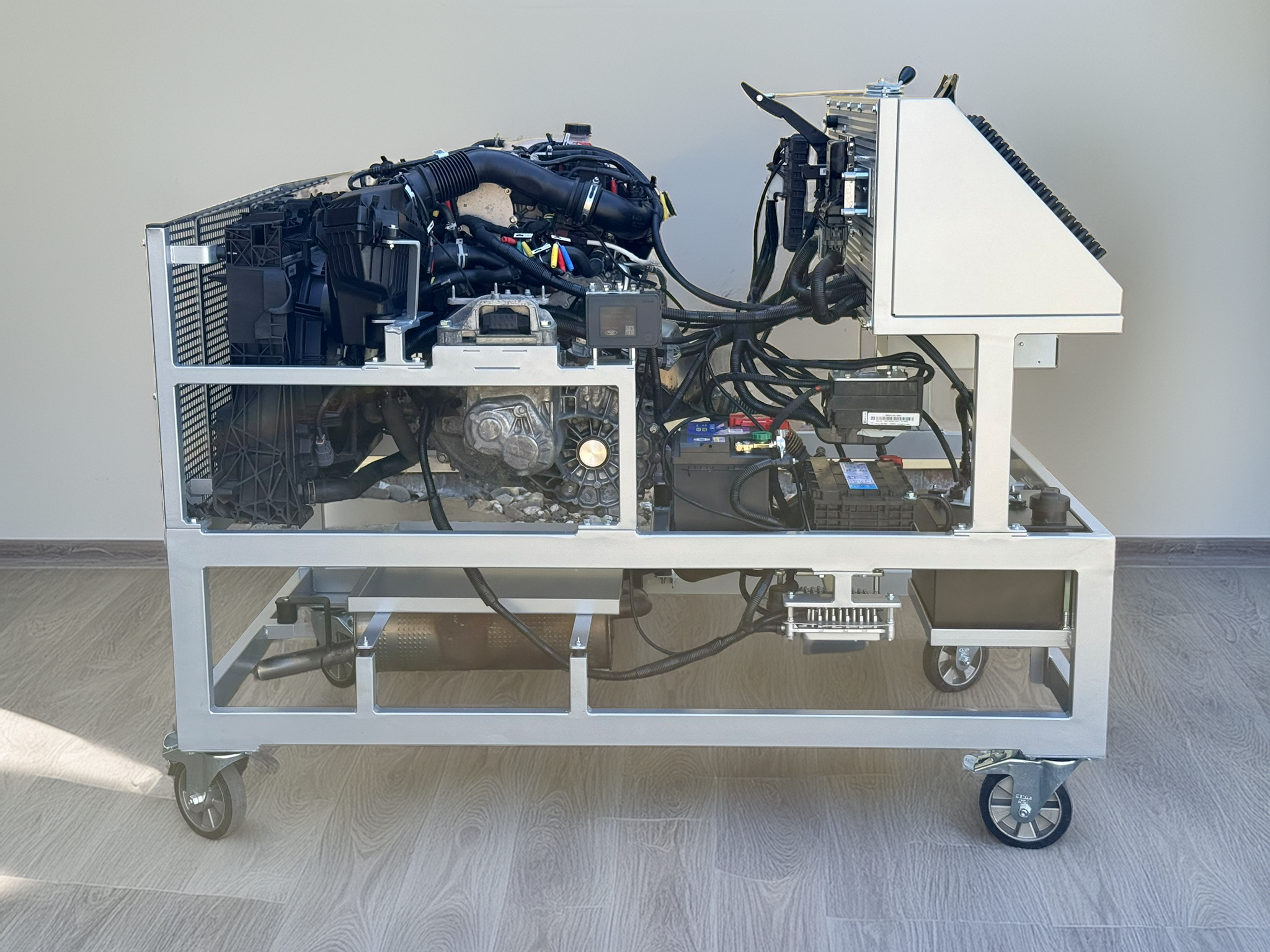
Original vehicle drivetrain with 12- and 48-volt systems
The training rig combines the original 1.0-liter EcoBoost engine with the components of the 48-volt mild-hybrid system.
The interaction of the combustion engine, electric assistance, energy storage and different voltage levels can be examined directly on the real system.
“Motronic” functional model
Compact analogue model for clearly demonstrating the basic principles of electronically controlled gasoline mixture preparation.
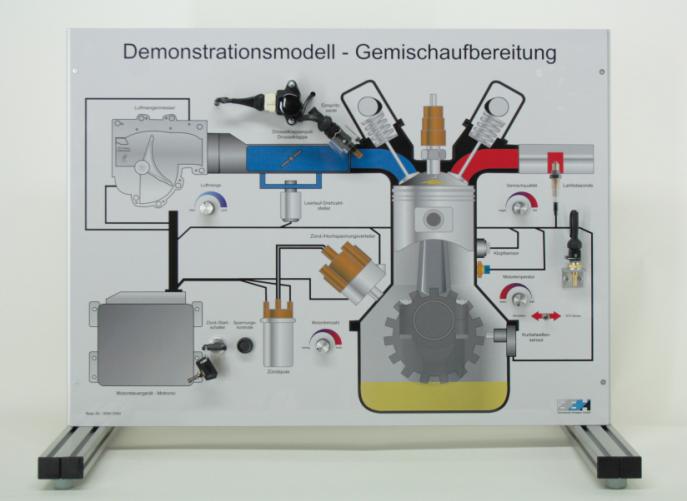
Clearly demonstrate sensors, actuators and fuel metering
The analogue model teaches and demonstrates the basic principles of electronically controlled mixture preparation. It shows how the air-flow signal, engine temperature, load condition and lambda-sensor voltage influence mixture composition.
By varying engine speed, engine load, engine temperature, air flow and lambda-sensor voltage, students can follow fuel metering, idle-speed control and overrun fuel cut-off. An integrated PC measurement interface records the operating values of the injection system.
The accompanying PC software displays measured values graphically as an oscilloscope or line recorder and numerically, while explaining the functions of the individual components.
Measurement and diagnostic equipment
Depending on the engine, we can add test sockets, breakout boxes or fault simulation to support different diagnostic exercises.
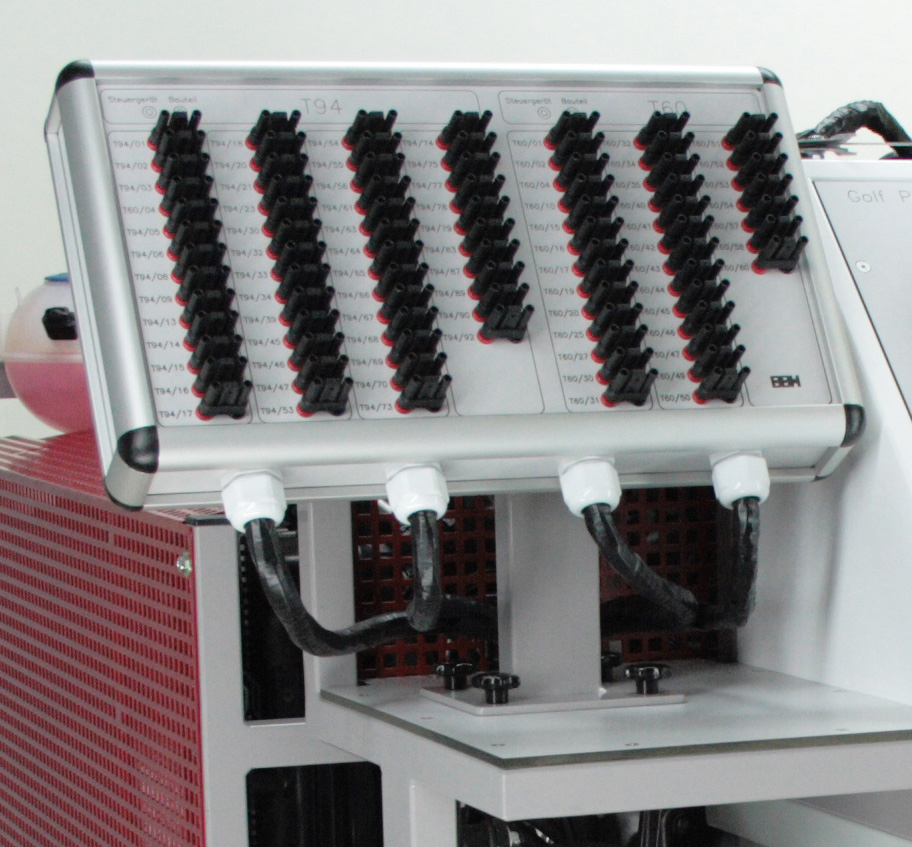
Breakout box
A permanently installed breakout box enables voltage and resistance measurements directly between the control unit and the vehicle system.
The pin assignment is displayed clearly. Bridging plugs allow measurements without completely disconnecting the control unit.
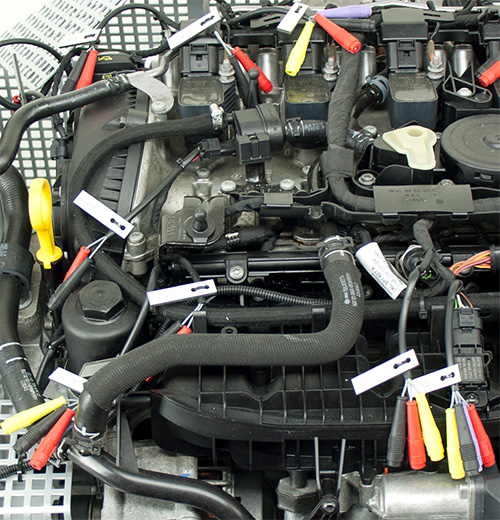
Measurement sockets on sensors and actuators
Color-coded 4 mm measurement sockets enable measurements directly at selected sensors and actuators.
Voltages, resistances and signals can be examined without having to open the original wiring harness for every measurement task.
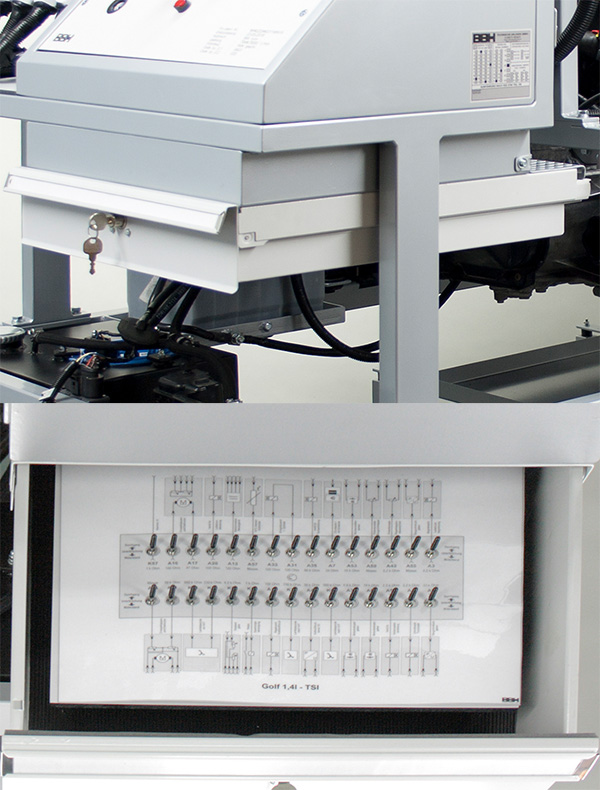
Manual fault simulation
Depending on the configuration, electrical faults can be deliberately introduced into the system using a protected fault-simulation unit.
Open circuits, short circuits and shorts to ground provide realistic tasks for diagnostics and systematic troubleshooting.
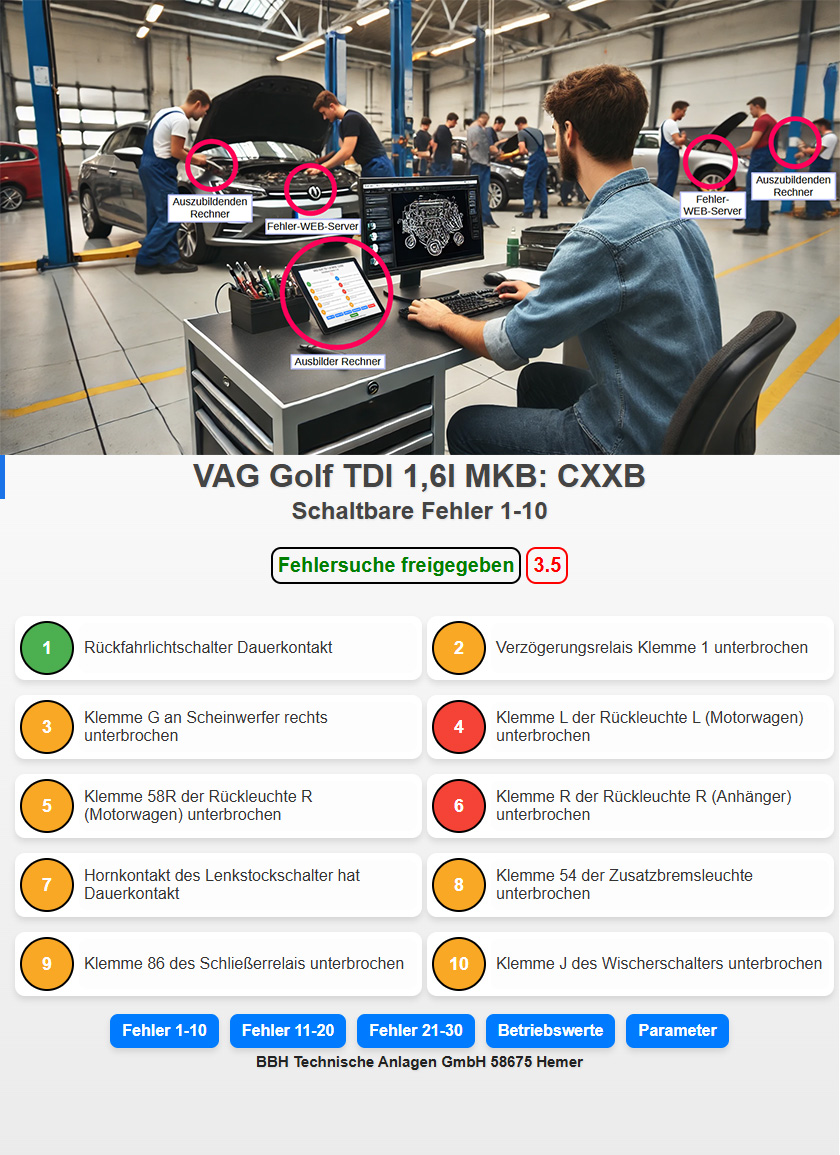
BBH IoT fault simulation
The web-based fault-simulation system allows faults to be introduced and cleared using a standard web browser.
A PC, tablet or smartphone can be used as the control device, enabling flexible training and examination scenarios.
Note: AI-generated image
Working with an engine training rig
The same rig can be used for everything from identifying engine components to diagnosing faults.
System design
Learn about the engine, control units, sensors, actuators and electrical supply within the overall system.
Operating states
Observe and evaluate engine data, operating states and control strategies on the actual running system.
Measure
Record voltages, resistances and electrical signals directly at the control unit, sensors and actuators.
Diagnose
Combine fault memory, measured values and electrical tests into a structured diagnostic procedure.
Functional engines from different manufacturers and drivetrain concepts
In addition to the systems shown in detail, further engine and drivetrain systems from different manufacturers can be built as fully functional training rigs.
Real drivetrain technology for different training objectives
The functional engines can be configured according to the level of training and teaching focus – from engine-management fundamentals to diagnostics of complex hybrid and high-voltage systems.
Frequently asked questions about functional engine rigs
Which types of engine are available?
We can build training rigs with petrol and diesel engines, as well as mild- and full-hybrid drivetrains from different manufacturers.
How can learners practise engine fault finding?
Learners can read diagnostic data, take measurements at the available test points and, where fitted, investigate deliberately introduced faults.